The industry’s attention still gravitates toward the legacy states. But through operators like SWADE Cannabis and its parent, BeLeaf Medical Co., Missouri has become one of the most dynamic cannabis stories in the country.
Ask most cannabis insiders which states matter, and you’ll hear the usual suspects: California. Colorado. Maybe Michigan or New York. Missouri rarely makes the first cut. That may be the industry’s biggest blind spot.
Yet on the measures that count right now—sales, stability, the ambition of the operators building there—it has quietly become one of the country’s most compelling markets, and one of the few still climbing while others stall.
Much of that story runs through a single company. SWADE Cannabis, the retail brand owned by BeLeaf Medical Co., opened in 2021 as one of Missouri’s first dispensaries and has spent the years since scaling into one of the state’s defining operators. They are vertically integrated, statewide, and built for a market that keeps maturing around it.

A Market That Keeps Setting Records
Missouri launched adult-use sales in February 2023, and the numbers since have been hard to argue with. State retailers reported a record $1.5 billion in cannabis sales in 2025, up about 4% over the year before, with adult-use purchases making up nearly 90% of the total, according to the Missouri Department of Health and Senior Services.
That figure lands harder in context. While several established markets contract, like how Colorado’s annual sales slid to $1.32 billion last year, and Michigan’s legal sales dropped sharply after a January tax hike, Missouri has kept growing, pushing cumulative sales past $4.9 billion since legal sales began in 2020.

Part of the state’s edge is structural. Because Amendment 3 wrote legalization directly into the Missouri constitution, operators work from a legal foundation that local or state officials can’t easily unwind, allowing companies to plan and expand without bracing for sudden political reversals.
Another part is homegrown, literally: every gram of cannabis sold in a Missouri dispensary has to be grown in the state, keeping cultivation, jobs, and tax dollars inside its borders. For a market barely three years into adult use, that combination of steady demand and legal durability has made Missouri a magnet for new and established brands alike.


Why Vertical Integration Matters Here
The clearest sign of how Missouri’s operators built for this moment is vertical integration. Rather than specializing in one link of the supply chain, companies like BeLeaf Medical Co. handle the whole run of cultivation, manufacturing, and retail in-house.
“We are a vertically integrated cannabis company, which is super beneficial in the industry, as we have the ability to do all functions necessary to operate,” says Kevin Riggs, CEO of BeLeaf Medical Co. “This means we can grow, sell, and transport our products anywhere in the state.”
The approach has drawn notice across the state’s cannabis industry. Greenway Magazine named BeLeaf Medical Co. its 2025 Company of the Year, while Sinse earned Brand of the Year recognition and picked up 2026 product honors, including a Best Pre-Roll win for Blueberry Muffin and Best Vape AIO for Pink Lemonade. The recognition extends beyond the shelf, too: BeLeaf Medical Co. co-founder Mitch Meyers was named to Inc.’s 2025 Female Founders 500 for her leadership in cannabis.
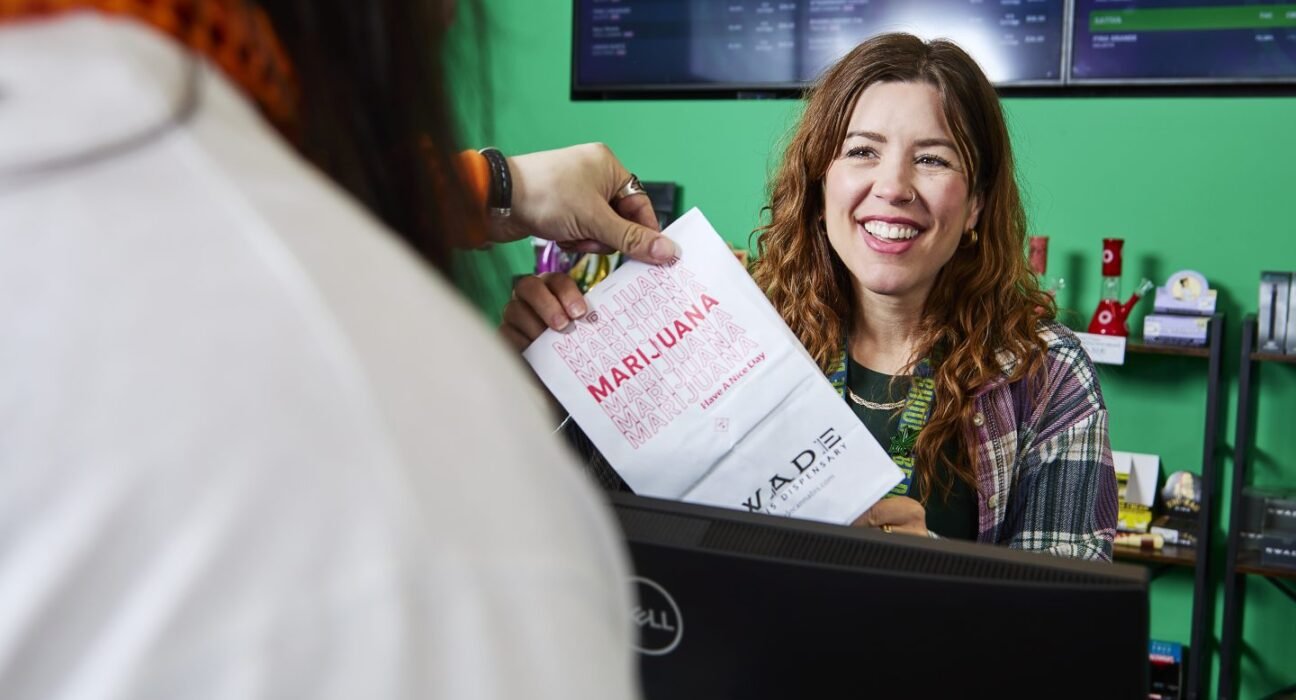
Integration also lets a company invest in the parts of retail that pure resellers tend to skip. SWADE’s Overland store runs a 24/7 preorder drive-thru pickup window, the first of its kind in St. Louis, and its same-day, discreet delivery reaches customers across its service areas, with the full menu available to browse and order online. It’s the sort of modern-retail access still uncommon in much of the country, and easier to pull off when one company controls the product from seed to sale.

Scaling Across the State
Reach is its own signal of a maturing market, and SWADE has been building it quickly. The company now operates 12 dispensaries across Missouri, and much of its Kansas City footprint came from taking over a group of former BesaMe Wellness locations. An expansion that carried a St. Louis-rooted brand clear across the state.
That pattern says something about the market itself. When established operators are scaling into new metros through acquisition rather than a market being flooded with first-time entrants, it’s usually a sign the industry is consolidating and professionalizing—maturing, in other words, the way older consumer categories eventually do. Missouri, only a few years into adult use, is already showing that shape.
Where the Money Goes
The maturation shows up in the state’s ledgers, too. Missouri’s legal cannabis industry generated a record $255.57 million in sales-tax revenue in 2025, divided between state government and the local jurisdictions that host a licensed store. By constitutional design, the state’s share of adult-use tax dollars is then routed to a specific set of beneficiaries: health care and services for military veterans and their families, the state’s public defender system for low-income residents, and substance-use treatment programs.

That structure ties every legal purchase to services a lot of Missourians depend on, and it recasts the dispensary as a civic contributor rather than a merely tolerated business.
For an operator like SWADE, that becomes part of the case it makes to customers. Buying from a licensed store isn’t only about product safety and quality; it’s about where the dollars land once the sale is done.
A Market Worth Watching
Missouri’s cannabis story is still being written, and no single company defines it. But SWADE Cannabis and BeLeaf Medical Co. make a useful case study for why the state has climbed into the top tier. A homegrown operator using in-state cultivation, vertical integration, and steady expansion to build something meant to outlast the early rush.
The runway ahead looks long, too. Several of Missouri’s neighbors still lack a legal adult-use market, which keeps regional demand pointed squarely at the state’s dispensaries, while an ongoing rollout of microbusiness licenses reserved for disadvantaged owners stands to bring a wave of new craft operators into the mix.
The legacy markets will keep drawing the headlines. Missouri, in the meantime, just keeps setting the records. For companies like SWADE, that’s the opportunity. Not simply to grow alongside Missouri’s cannabis industry, but to help define what its next chapter looks like.
All photos courtesy of SWADE Cannabis
Sponsored Content Disclaimer: This article was published as part of a paid commercial arrangement with SWADE Cannabis. It is not independent editorial content. References to products, services, cannabinoids, formulations, consumer use cases, or company claims reflect the company’s perspective unless otherwise noted and have not been independently verified by High Times.


![[Watch] High Times’ New Travel Series Goes From Mallorca’s Underground To Portugal’s Cannabis Boom](https://weeddailydigest.com/wp-content/uploads/2026/03/Watch-High-Times-New-Travel-Series-Goes-From-Mallorcas-Underground-551x431.jpg)